

Rich Planning vs. Poor Planning
Massachusetts to Florida estate planning is no longer a niche—it’s a powerful strategy used by high-net-worth individuals like Shark Tank’s Kevin O’Leary. Rich Planning and Poor Planning lead to very different families. I saw it firsthand. With Poor Planning, my family suffered a terrible probate when my grandfather passed away. It destroyed my family. My dad, uncle and grandma litigated each other to death in probate court. My grandfather’s legacy was shattered. There was no peace. Our family was left in pieces.
After that, my mother married into a family who had great estate planning. I experienced Rich Planning. In my new family, our patriarch relocated from a high-tax, trust-unfriendly state to Florida. He established a dynasty trust, effectively preserving the family’s wealth for multiple generations.
I became a lawyer to promote Rich Planning and fix problems caused by Poor Planning. I help families experiencing the results of Poor Planning by litigating in probate court. I help affluent families implement Rich Planning to protect and grow their legacies.
Why Wealthy Families Choose Massachusetts to Florida Estate Planning
I have seen a surge of wealthy individuals moving from high-tax states to Florida in recent years. In my Florida legal practice, I regularly encounter clients who have fled states like New York, New Jersey, California – and especially Massachusetts – seeking relief from punitive taxes. This trend isn’t just anecdotal; it’s backed by hard numbers. From 2020 to 2023, roughly 2.8 million more Americans moved out of high-tax states than moved in. Florida has been the number one beneficiary, drawing a net influx of about $17.7 billion in adjusted gross income in a single year. The reason is simple: families and business owners are voting with their feet, escaping oppressive tax burdens to protect their wealth for themselves and their heirs.
One well-known example – which really brings this lesson home – is Kevin O’Leary, the Canadian-American businessman and Shark Tank star. O’Leary famously dubbed Massachusetts “Taxachusetts” due to its high taxes, and he decided he’d had enough. “There’s a reason that everybody moves from Massachusetts to Florida,” O’Leary quipped. In his view, Florida is a winner state with a pro-business, pro-wealth climate, whereas Massachusetts had become a loser with sky-high taxes. O’Leary actually relocated his domicile from Boston, MA to Miami Beach, FL, explicitly to take advantage of Florida’s lack of state income and estate taxes. When a multi-millionaire who can live anywhere chooses Florida over Massachusetts, it’s worth examining why.
The lesson is clear: Tax-heavy states can bleed away family wealth through income taxes, estate (death) taxes, and other levies. In contrast, Florida’s tax policies allow affluent families to keep and grow their wealth across generations. Below, I’ll break down exactly why Massachusetts earned the moniker “Taxachusetts,” how Florida’s laws differ, and what happened in Kevin O’Leary’s case. I’ll also share a heartbreaking example of how failing to plan for these taxes can destroy a family’s financial legacy – and how a Florida relocation and proper estate planning (what I call “Rich Planning”) can save the day.
Massachusetts’ Punitive Tax Laws and Estate Planning Risks
Massachusetts has long been infamous among the wealthy as one of the least favorable states for taxes on high earners and estates. As an attorney, I’ve helped clients decipher just how harsh the Bay State’s tax bite can be. Let’s look at two major components: the estate tax and the income tax (not to mention other high taxes).
Massachusetts Estate Tax Impact on Estate Planning

Massachusetts is one of only 12 states (plus D.C.) that still impose a state estate tax, and it has had one of the lowest exemption thresholds in the nation. In plain English, this means Massachusetts will tax the estates of people who die as residents (or who own property there), even if the estate isn’t large enough to owe federal estate tax. Until recently, any Massachusetts estate over $1 million in value was subject to state estate tax – a threshold so low that even middle-class families with a home in Boston could cross it. (For context, Massachusetts and Oregon historically had the lowest estate tax exemption of $1 million, far below the national median of around $4–5 million.) In 2023, Massachusetts lawmakers finally recognized how punitive this was and doubled the exemption to $2 million. However, even at $2 million, Massachusetts’ exemption is still tiny compared to most states (many of which have no estate tax at all).
What does this estate tax cost families? Massachusetts estate tax rates run from 0.8% up to 16% on the value of the estate above the exemption. The top rate of 16% kicks in for larger estates, meaning the state can take a sizable chunk of what you hoped to leave your children. To add insult to injury, until the recent law change, if you were even $1 over the threshold, the tax applied to the entire estate value (a brutal “cliff effect”). Thankfully that cliff has been fixed so that only the value above the $2M threshold is taxed. Still, a 16% tax is nothing to scoff at – it’s essentially a death tax on top of the federal estate tax (which only applies over ~$13 million per person in 2024).
Let me illustrate with a heartbreaking example. I once consulted with a family (let’s call them Joan and Terry) who had moved from New York to Massachusetts to enjoy their retirement in the Berkshires. In New York, their estate – about $4.25 million – would have owed $0 in state estate tax because New York’s exemption was nearly $7 million. But in Massachusetts, with a $2 million exemption, Joan and Terry’s estate faced an estimated $123,000 in Massachusetts estate tax. That’s not just a number – that $123k is nearly four years of college tuition for a grandchild, or a down payment on a home, or a charitable gift the couple wanted to leave. Instead, without planning, it would go to the Commonwealth of Massachusetts. I remember Joan’s voice shaking as she said, “That money was supposed to help our grandkids, and now the state could take it.” Without proper planning, estate taxes can shrink your legacy by up to 16%, forcing the sale of assets (like the family home or business) that you intended to pass to your children. I’ve seen estates where the heirs had to quickly sell off property – even the house their parents lived in – just to pay a six-figure tax bill. It’s heartbreaking and completely avoidable with the right strategy.
Why is Massachusetts so tough? It comes down to policy choices. The Massachusetts estate tax is mandated by state law (Mass. Gen. Laws ch. 65C). It essentially used to “pick up” where a federal credit left off, but even after the federal law changed, Massachusetts kept this tax in place. The state only recently acknowledged it was an “outlier” and passed some relief, as I mentioned (raising the exemption to $2M). But the bottom line is, if you are a Massachusetts resident with even modest wealth, the state will take a bite out of your estate when you die, unless you plan around it or change your residence.
Contrast this with Florida – and you’ll see why so many wealthy Massachusetts families establish Florida residency. Florida has no estate tax at all. If Joan and Terry in the example above had been Florida residents, their $4.25 million estate would owe $0 to the State of Florida. All that money would go to their chosen heirs or charities. That difference – $123,000 versus $0 – is one lesson in why rich folks flee “Taxachusetts” for the Sunshine State.
Massachusetts Income Tax & Its Effect on Estate Planning
The pain doesn’t stop at death. Massachusetts also subjects its residents to high income taxes during life, which is another reason many successful individuals don’t retire there (or even mid-career, they relocate). Massachusetts has a state income tax of 5% on most income (interest, wages, etc.), with certain income (short-term capital gains, certain collectibles) historically taxed at 12%. And as of 2023, Massachusetts got even more aggressive: voters approved a new “Millionaire’s Tax” constitutional amendment. Now, any income over $1,000,000 in a year is hit with an extra 4% surtax. In effect, a high earner in Massachusetts could be paying 9% state income tax on every dollar over $1M. This surtax doesn’t just hit salaries – it can hit trusts, business income, even one-time capital gains on selling a home or business. For example, if you sell a company and realize a $5 million gain in one year, Massachusetts will want 9% of the amount over $1M. That’s tens of thousands of dollars (or more) siphoned away from your nest egg, simply because you live in Massachusetts. Kevin O’Leary cited this as a major factor: “I couldn’t afford to live in Boston anymore,” he said – and this is a man whose net worth is around $400 million! Of course, O’Leary was being a bit tongue-in-cheek (he’s clearly wealthy enough to live anywhere), but his point was that Massachusetts’ new taxes on high earners made it fiscally irrational for him to stay. Why pay a million-plus per year in state taxes when you can pay $0 by moving to Florida?
In addition to income and estate taxes, many high-tax states pile on other taxes: property taxes, sales taxes, etc. Massachusetts property taxes are quite high, especially in and around Boston. While Florida also has property taxes, Florida’s homestead exemption can significantly reduce property tax on a primary residence, and Florida caps annual assessed value increases (the Save Our Homes cap) to protect homeowners from huge tax jumps. And on sales tax, Massachusetts is about 6.25% statewide, whereas Florida is around 6% (varying slightly by county). The differences in those may be marginal, but the real “tax heavy” reputation comes from Massachusetts’ income and estate levies – and those are exactly the taxes Florida foregoes to attract wealthy residents.
To sum it up, Massachusetts earned the nickname “Taxachusetts” by taxing income heavily (especially for millionaires) and clinging to an estate tax that hits even moderately wealthy families. This combination is lethal to a family’s long-term wealth. I often tell clients in Massachusetts: Every year you stay, you’re potentially burning money that could have stayed in your family. It’s no wonder that folks who have the means are looking for an escape hatch. And Florida has opened its doors wide to welcome them.
Florida as a Destination for Massachusetts to Florida Estate Planning
Florida has carefully cultivated an image as a tax haven, and in my experience, it’s not an exaggeration. The state constitution and laws make Florida extremely friendly to high-net-worth individuals and anyone serious about preserving wealth. Let’s break down Florida’s key advantages on the tax front, and also a lesser-known edge: Florida’s trust and asset protection laws that pair beautifully with its tax climate.
Florida’s Tax Advantages in Estate Planning
The headline is simple but stunning: Florida has no state income tax, no estate tax, and no inheritance tax. For someone moving from Massachusetts, New York, New Jersey, California, or similar states, this is like a breath of fresh air. Here’s what that means in practical terms:
- No State Income Tax: Florida is one of only a few states with zero personal income tax. This is enshrined in Florida’s Constitution – Florida cannot tax income of natural persons (aside from certain intangible taxes which were also largely repealed). So whether you earn $50,000 or $50 million a year, Florida will not take a penny of it. Compare that to Massachusetts’ new 9% top rate on million-plus earners – a Florida resident with $5 million of income saves roughly $400,000+ every year in state income tax versus a Massachusetts resident. That’s money that can be reinvested, spent, or given to family instead of sent to Boston. I’ve personally helped clients restructure their businesses and residency so that income flows through Florida, saving them high five-figures or six-figures annually in state taxes. Over a decade, those savings easily reach into the millions. As an attorney, it’s gratifying to tell a client, “Yes, moving to Florida means you keep an extra 5–10% of your income each year,” and see the relief on their face.
- No Estate Tax: Florida has no “death tax” on the state level. This wasn’t always the case – historically, Florida had a pickup estate tax that matched a now-defunct federal credit, but today it’s gone and even prohibited unless the federal law changes. The result: When a Florida resident passes away, Florida does not impose any estate tax on the transfer of their assets to heirs. Only the federal estate tax might apply for very large estates (over ~$12.9 million per person in 2023). This is a huge selling point. In our earlier example, Kevin O’Leary’s estate is reportedly in the hundreds of millions. If he were still in Massachusetts at death, his estate could owe tens of millions to Massachusetts alone. In Florida, his estate would owe $0 to the State of Florida, meaning more for his wife, children, or charities. That difference can preserve a family business or keep generational wealth intact. I often help new Florida residents create or update their estate plans to take advantage of Florida law – for instance, establishing Florida-based trusts that won’t be subject to another state’s taxes. We might also shift ownership of real estate or businesses to Florida entities, so that even assets physically in another state are not subject to that state’s estate tax (there are strategies to do this legally). The goal is to cut off the old state’s taxing authority as much as possible once you’re a Floridian.
- No Inheritance Tax: Inheritance tax is a cousin of estate tax – instead of taxing the estate, it taxes the recipients of the inheritance. States like Pennsylvania, New Jersey, Maryland, and others have inheritance taxes that hit the heirs (often with exemptions or lower rates for close family, and high rates for distant relatives or friends). Massachusetts, to its credit, does not have an inheritance tax – it chose the estate tax route instead. But Florida has neither. If you’re a Florida resident, you can leave your fortune to your children, and Florida won’t tax them for receiving it. They get to enjoy the full value of what you left (aside from any federal estate tax considerations, which we plan for separately). This is a tremendous relief for, say, a patriarch who wants to leave a legacy to his kids or a matriarch funding her grandchildren’s trust – Florida won’t skim off the top.
All told, Florida’s lack of these taxes amounts to a giant competitive advantage in attracting and retaining wealthy individuals. Kevin O’Leary has praised Florida’s tax climate repeatedly, noting that Florida is on a “winning streak” because of these pro-growth policies. In one forum, O’Leary pointed out that in some parts of the country “individuals can move their residencies or businesses a few miles and be in a much better tax climate”. Florida exemplifies that better climate. I often joke with clients that Florida should put on its welcome signs: “Welcome to Florida: You’ve arrived at Tax Freedom.” It really can feel that way for someone escaping Taxachusetts or the Empire State’s tax empire.
To put a number on it: A high earner from New York (say $650,000 annual income) could save about $70,000 every year just by becoming a Florida resident. A similar earner from New Jersey would save around $58,000 a year moving to Florida. That’s like finding extra salary without working more – courtesy of Florida’s tax laws. For ultra-high-net-worth families, the savings on estate taxes could be in the millions or tens of millions of dollars for their heirs. These are life-changing sums.
Florida’s Trust Laws for Estate Planning
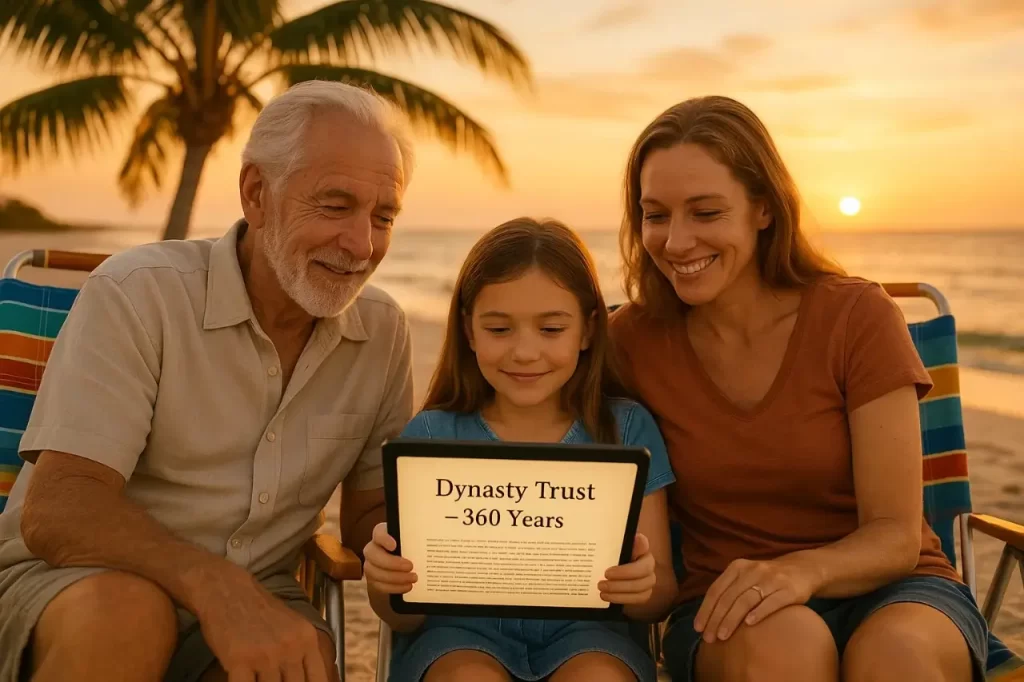
Beyond the headline of “no taxes,” Florida is also incredibly attractive for estate planning tools that preserve wealth, such as dynasty trusts. In the “Rich Planning vs Poor Planning” story above, I mentioned our family’s patriarch set up a dynasty trust after moving to Florida. Let me explain why Florida is ideal for that and what it means.
A dynasty trust is a long-term trust meant to last for multiple generations, so that wealth can be passed down within the trust without being drained by estate taxes at each generational transfer. However, not every state allows trusts to last indefinitely – many states have a “Rule Against Perpetuities” that forces trusts to end (often after about 90 years or at the death of some life in being plus 21 years, in classical terms). Florida, by contrast, has extended its allowable trust duration to an extraordinary length: Florida trusts can last up to 360 years (and for some trusts created in 2022 and beyond, up to 1,000 years in certain cases). In practical effect, Florida law permits perpetual or near-perpetual trusts. This is hugely advantageous for wealthy families. It means you can establish a Florida trust that could hold family assets for many generations – perhaps 10 or more generations – without ever being forced to terminate and distribute (which would potentially trigger estate taxes at each distribution).
Not only that, but Florida’s absence of state income tax means that a trust sitused in Florida pays no state income tax on its earnings (important for irrevocable trusts that accumulate income). If you set up the same trust in, say, California, the trust’s income might be taxed at California’s high rates. Florida also has robust asset protection for trusts. For instance, a properly structured dynasty trust in Florida can be protected from beneficiaries’ creditors, divorcing spouses, etc., for as long as it exists. This is part of what I call “trust-friendly” laws.
Most pertinently, Florida imposes no state-level estate or generation-skipping tax on transfers to or from trusts. Other states that have estate taxes can diminish the value of a long-term trust. As one legal commentator noted, “Most other states do not have Florida’s generous rule which allows trusts to last 360 years, and other states also have state estate taxes that take away from the trust’s value.”. In other words, Florida lets your trust live virtually forever and lets the assets grow undisturbed by state taxes, whereas a trust in a state like Massachusetts might get whacked with state estate tax whenever it eventually distributes to the next generation.
In my practice, I frequently assist affluent clients in establishing Florida dynasty trusts after they become Florida residents. For example, if you’ve moved from Massachusetts to Florida, we might create a new irrevocable trust in Florida for the benefit of your children and future descendants. You can transfer assets into that trust (often utilizing federal gift tax exemptions or other techniques to avoid immediate tax). Once in the trust, those assets can grow and eventually pass to your grandchildren, great-grandchildren, etc., without ever incurring a Massachusetts estate tax or any state inheritance tax. Meanwhile, the trust can purchase assets (like real estate, investments, life insurance) and manage them with professional guidance, and the family can benefit from the wealth through trust distributions across generations.
Florida’s trust code and laws also permit things like directed trusts, decanting of trusts, and other modern trust administration tools that give flexibility to adapt the trust over a long lifespan. And remember, because Florida has no income tax, the trust’s income is only subject to federal tax, which simplifies things greatly.
In short, Florida isn’t just a tax haven – it’s an estate planning haven. It allows what I call “Rich Planning” at its finest: you can legally avoid state taxes and employ advanced strategies (like dynasty trusts and other asset-protection trusts) to shield and grow your family’s wealth. States like Massachusetts, on the other hand, not only tax you heavily but also may not permit such long-term trusts (Massachusetts law generally would force a trust to end at some point due to the perpetuities rule, and if that trust’s assets came out in the future, Massachusetts would try to tax them if the recipient is in Mass or the trust was governed there). Florida offers a more permanent solution.
Now, to ground all this in a real story, let’s return to Kevin O’Leary’s move and see exactly what he gained – and what Massachusetts lost – when he fled Taxachusetts for Florida.
Kevin O’Leary Case: Massachusetts to Florida Estate Planning Example

Kevin O’Leary’s very public relocation from Boston, MA to Miami, FL provides a textbook case of the benefits we’ve been discussing. As an attorney focusing on estate planning and tax strategies, I find cases like this resonate with clients – O’Leary essentially did what I advise many wealthy families to consider: establish Florida domicile to save on taxes and secure your wealth.
Kevin O’Leary’s Assets in Estate Planning Context
First, let’s understand who Kevin O’Leary is and what assets he had when he made this move. Kevin O’Leary (often known as “Mr. Wonderful” on Shark Tank) is a seasoned entrepreneur and investor. He co-founded a software company in the 1990s (The Learning Company) that was sold for billions, and since then he’s built a diversified empire. At the time of his domicile change to Florida, O’Leary’s net worth was reported to be around $400 million. This includes various asset classes:
- Business Holdings: O’Leary is the chairman of O’Leary Ventures and has equity stakes in numerous companies (some public, some private). Through Shark Tank deals alone, he’s invested in startups spanning consumer goods, technology, and beyond. These venture investments and business interests form a significant part of his wealth. Many of these investments can throw off income (dividends, profits, etc.) or will eventually result in capital gains when sold.
- Financial Assets: Like many wealthy individuals, Mr. O’Leary likely holds a substantial portfolio of stocks, bonds, and other securities. In fact, he has O’Shares Investments (which offers ETFs), indicating he has large positions in the market. These financial assets produce income (interest, dividends) and capital gains – all of which were subject to Massachusetts taxes when he was a resident there.
- Real Estate: Kevin O’Leary owned a primary residence in the Boston area (which, by rumor, he sold or at least left when moving south). He also owns property in other places (he’s Canadian by birth and has had property in Canada too). Upon moving, he bought a home in Florida (Miami area). Real estate forms part of his asset mix and is relevant because where your real estate is located can affect estate taxes. (Massachusetts, for example, taxes Massachusetts real estate of non-residents in an estate scenario, and also capital gains on sale if not planned around.)
- Personal Assets: This can include luxury items like boats (he’s known to enjoy boating), art collections, etc. While not confirmed, it’s common for someone of his wealth to have significant personal property of value.
- Intellectual Property & Royalties: As a TV personality and author, Kevin O’Leary has income from TV contracts, book royalties, appearance fees, etc. These are income streams tied to his personal brand.
Why list all this? Because each of these asset categories gets different tax treatment under Massachusetts vs. Florida. By moving to Florida, O’Leary changed the tax equation for each:
- Business/Venture Income: As a Florida resident, if his businesses are structured properly, Massachusetts can no longer tax his business profits or capital gains. For example, if he sells a stake in a company for a $10 million gain, Massachusetts would have taken 5% (or 9% if it pushes him over $1M that year). Florida takes 0%. That’s up to $900,000 saved in one transaction. If his ventures pay him dividends or pass-through income, that used to be Massachusetts taxable; in Florida it’s not.
- Stock Portfolio: Florida doesn’t tax dividends, interest, or capital gains at the state level. Massachusetts taxed all of that at 5% (and short-term gains at 12% prior to 2023). So moving his official residence to Florida means all the income from his investments is free of MA tax. Given a $400M portfolio, even a modest 5% annual yield is $20M in income. In Massachusetts that could incur about $1M in state tax each year (more if the income is short-term gains). In Florida: $0 state tax on it.
- Real Estate: By becoming a Florida domiciliary, O’Leary made his Florida home his primary residence. He likely took steps to declare homestead in Florida (which provides asset protection and tax benefits for that home). Any gain on selling his Massachusetts home may have been subject to Massachusetts tax while he was a resident, but by leaving, he might avoid Massachusetts tax on future appreciation. If he retains any property in Massachusetts, he’d want to structure it perhaps via an LLC to avoid Massachusetts estate tax prying into his estate. Meanwhile, his Florida real estate enjoys homestead protection (creditors can’t force sale to satisfy debts, generally) and no state estate tax. If O’Leary passed away a Florida resident, Florida would not tax his Florida real estate at death, whereas Massachusetts certainly would have taxed his Massachusetts home if he died a Massachusetts resident.
- Personal Property: Things like boats, art – Florida has no personal property tax on such items (aside from vehicle/boat registration fees), whereas some states have tangible property taxes. Minor point, but still a factor. Also, if those items are part of his estate, Florida doesn’t tax their transfer at death; Massachusetts would.
In summary, Kevin O’Leary’s assets at the time of his move were substantial and diverse. By switching his domicile to Florida, he placed himself in a position to protect those assets from state taxation going forward. It’s like performing a “tax transplant” – moving to fertile ground (Florida) from rocky soil (Massachusetts). Let’s put dollar figures to what he likely saved.
Estate Tax Savings in Massachusetts to Florida Estate Planning
It’s difficult to know the exact figures without seeing Mr. O’Leary’s tax returns, but we can estimate the savings based on public information and typical scenarios. O’Leary himself has hinted at these savings in various interviews.
- Annual Income Tax Savings: As noted, Kevin O’Leary’s net worth is about $400 million. A conservative estimate of income from that net worth (through investments, businesses, etc.) might be in the range of $10–$20 million per year. Let’s assume roughly $15 million of taxable income per year for him (it could be higher some years). If he were a Massachusetts resident, the first $1M of that would be at 5%, and the remaining $14M at 9% (due to the new surtax). Rough math: $1M * 5% = $50,000, plus $14M * 9% = $1.26 million. That’s about $1.31 million per year in Massachusetts state income tax. In Florida, the same income is taxed at 0% by the state – so he saves that entire amount. Even before the millionaire surtax, Massachusetts would’ve taken around $750k (5% of $15M). With the new law, the tax would be higher. So O’Leary is likely saving on the order of $1 million+ per year in state income taxes by living in Florida. Over, say, a decade, that’s over $10 million saved, growing potentially as investments compound. It’s no wonder he said he “couldn’t afford” Boston – why voluntarily lose a million bucks each year to the state when you don’t have to?
- Estate Tax Savings: This is the real whopper. If Kevin O’Leary had stayed a Massachusetts resident and (hypothetically) passed away with $400 million in assets, Massachusetts would impose its estate tax on his estate. With a $2M exemption, that leaves $398M taxable. Massachusetts estate tax is graduated but tops out at 16%. Rough estimate, the tax bill would be in the ballpark of $60–$64 million (it could be a bit less if effective rate is a bit lower, but it’s tens of millions regardless) going to the state before his heirs see a dime. Florida, by contrast, would impose $0 state estate tax. His estate would only face the federal estate tax (which at that level is 40% on amounts over the federal exemption, but we can mitigate some of that with advanced planning too). By moving to Florida, O’Leary effectively spared his estate from Massachusetts’ death tax. In essence, he protected maybe $60 million of his legacy for his family or charities. That is a massive lesson: wealthy individuals can literally buy an extra vacation home in Florida and save an amount equal to a whole other fortune in taxes.
- Capital Gains / Business Sale Savings: O’Leary is an active investor. Suppose in a given year he has a big liquidity event – for instance, selling a company stake for $50 million. In Massachusetts, that single event would trigger roughly $2.5 million in state tax (5% of $50M; if it’s all long-term gain) or more if short-term. In Florida, that $2.5M stays with O’Leary. Multiply this by multiple deals over a lifetime, and you see the pattern. In an interview, O’Leary noted that states like Massachusetts make it very hard to justify staying if you’re investing and selling companies, because each success is disproportionately taxed. Florida encourages entrepreneurs by not penalizing their big wins with state tax.
- Property and Sales Tax Differences: These are smaller in comparison but worth noting. O’Leary’s Massachusetts home (if valued, say, $4M in Boston) might have property taxes of around 1%+ per year (maybe $40k). His Florida home at a similar value might have a similar nominal tax rate, but with Florida’s homestead rules, the assessed value increases are capped and he gets a homestead exemption (knocking off say $50k of value from taxation). Over time, Florida’s system likely results in less property tax growth. Also, Florida has no state-level estate tax on that home if he keeps it till death, whereas Massachusetts would have included it in the estate tax calculation. Sales tax differences likely don’t move the needle much for someone like him (Florida ~7% combined vs Massachusetts 6.25% – not huge).
It’s also important to mention quality of life and secondary effects: by basing himself in Florida, O’Leary can deploy his capital more freely. He joked that even with his wealth, Boston became “unaffordable” when you factor in future taxes. Now, as a Florida resident, he invests in local ventures, enjoys a booming Miami economy, and even noted that Florida’s government is more pro-business. As U.S. Senator Rick Scott commented when chatting with O’Leary, Florida gains a lot of retirees and wealthy transplants who then invest money into the state’s economy and charities. So not only does O’Leary save money, but Florida arguably benefits from his presence (whereas Massachusetts lost both his tax dollars and his investment capital).
From my perspective as a lawyer, the Kevin O’Leary case is a perfect demonstration of what savvy “rich planning” can accomplish. By changing his state of domicile to Florida, Kevin O’Leary likely saved seven figures per year in income taxes and potentially eight figures in future estate taxes. And he isn’t alone – many billionaires and centimillionaires have done the same math. Florida has attracted the likes of President Donald Trump (who changed domicile from New York to Florida, reportedly to save on taxes and other reasons), Carl Icahn (billionaire investor, moved from NY to Florida), hedge funders like Paul Tudor Jones and David Tepper, and countless others. O’Leary’s move might grab headlines because he’s on TV, but there are quiet moves happening daily by affluent families seeking the Florida advantage.
The takeaway for someone reading: If you live in a tax-heavy state and have significant assets or income, consider what a Florida domicile could do for you. The savings could be enormous, and those savings can be reinvested or used to enhance your family’s legacy rather than being lost to state coffers. Next, I’ll explain exactly what it means to establish a Florida domicile and how easy (or not) it is to do – because it’s not as simple as just buying a house. But it is quite straightforward if you follow the steps.
Establishing Florida Domicile for Estate Planning
Many clients ask me, “What does it mean to become a Florida resident for tax purposes? How do I actually do it?” The concept we’re dealing with is domicile – your legal residence. You can only have one domicile at a time, and it’s essentially the place you intend to be your permanent home. States use various factors to determine your domicile, especially if they want to contest that you left. Here’s what you need to know:
Domicile vs. Residence: You might own multiple homes and spend time in several states, but domicile is about where your true home base is. It’s the state that you consider your primary and permanent home, the center of your civic life. When you change domicile, you’re effectively saying, “This new state is now my home, and I do not intend to return to live in the old state.” For tax purposes, domicile is crucial because the domiciliary state can tax you on things like your worldwide income and your estate (whereas a non-domiciliary state generally can only tax limited things like property located there). So to escape Massachusetts taxes, for instance, you must break domicile with Massachusetts and establish it in Florida.
How to Establish Florida Domicile: Florida makes it pretty easy, but you do need to take some affirmative steps – both to satisfy Florida law and to cut ties with your former state. In my experience, here are the key steps (and I often guide my clients through each):
- Physically Move and Secure a Florida Home: You should have a place to call your own in Florida – whether that’s a house, condo, or even a rental if it’s truly your primary home. Typically, purchasing a home in Florida and designating it as your primary residence (homestead) is a strong move. It shows commitment. Plus, as a Florida homestead, you get property tax benefits and asset protection. Kevin O’Leary, for example, bought a home in the Miami area and that’s now his primary residence.
- File a Florida Declaration of Domicile: Florida has an official mechanism (Florida Statutes § 222.17) allowing you to declare that you are now a Florida domiciliary. You fill out a simple affidavit and file it with the Clerk of Court in your county of residence (for example, Miami-Dade County or Palm Beach County, etc.). This document states when you arrived in Florida to live and affirms that Florida is now your permanent home and that you’re relinquishing your old domicile. It’s not strictly required by law to have this document, but I strongly encourage it, because it’s evidence of your intent and it’s relatively easy (just needs to be notarized and filed, usually a small fee). I file these for clients regularly.
- Obtain a Florida Driver’s License and Vehicle Registration: Swap out that Massachusetts (or other state) driver’s license for a Florida driver’s license as soon as possible. Also register your car(s) in Florida and get Florida plates. These are concrete indicators of your new domicile. Florida law actually requires you to get a Florida license within 30 days of becoming a resident. And don’t forget to update insurance policies to Florida, etc.
- Register to Vote in Florida: Get on the Florida voter rolls and, importantly, if you were registered elsewhere, cancel your old voter registration. Voting is a powerful sign of intent. If you show up voting in Massachusetts after you claim to have moved to Florida, it can undermine your domicile claim.
- Update Estate Planning Documents to Florida: As an estate attorney, I always update my clients’ wills, trusts, powers of attorney, etc., to reference Florida as their domicile. For example, a new Florida Will might start, “I, John Doe, a resident of Miami-Dade County, Florida, declare this to be my Last Will…” This not only ensures your estate plan follows Florida law but also is another piece of evidence that you consider Florida home. It’s even advisable to include in the will a statement like “I am domiciled in Florida and intend to remain so.” Little things like that help fortify your position.
- Move your “life” to Florida: This means changing your primary bank accounts to Florida branches or banks, finding new Florida doctors (and transferring medical records down), moving the contents of any safe deposit boxes to Florida, joining local clubs or churches, basically embedding yourself in the Florida community. If you have pets, get them licensed with a Florida vet/local county tags. The more ties to Florida, the better.
- Sever ties to the old state (to the extent feasible): This is the flip side. You may still keep a home or business interests in the old state, but you want to clearly downgrade them as secondary. For instance, if you keep a summer house in Cape Cod, use it only part of the year and consider titling it in an LLC or trust. Stop using the old address for anything important. Change your mailing address for all accounts and bills to Florida. If possible, spend at least 183 days (more than half the year) in Florida, because some states use that as a bright-line test (though domicile is more about intent than counting days, it’s still a good practice to spend most of your time in Florida). Keep a log if needed to prove it. If you have a business, perhaps open a Florida office or relocate main offices here. Certainly, file non-resident tax returns or no tax returns as appropriate in the old state after your move, and file as a resident in Florida (Florida doesn’t have income tax returns, but e.g. file your federal return with your Florida address).
In essence, you want to create a picture where everything about you screams “Floridian now”. As a Florida attorney, I often provide clients a checklist just like the above. The good news is Florida doesn’t make you wait long or jump through hoops – there’s no minimum waiting period to become a domiciliary. If you take these steps today, you could today be considered a Florida resident for all important purposes. Of course, the longer you stay and maintain those ties, the more unassailable your domicile becomes. After a few years, it will be very clear to any observer that Florida is home. In the meantime, if a high-tax state ever audits or challenges your residency, you’ll have ample proof to show you made the switch.
One more thing: Establishing Florida domicile is one of the services I provide. I help clients ensure all the legal formalities are done right, and I counsel them on the softer factors that tax authorities look at. States like New York, for example, have entire teams that investigate wealthy people who claim to have moved – they check where your doctors are, where your art is located, where you spend holidays, etc. So I prepare clients to build a fortress of evidence that they indeed have left the old state behind. Florida, for its part, welcomes you with open arms and has even passed laws to make it hard for other states to collect taxes from former residents (Florida will not enforce another state’s tax judgments if they violate Florida public policy of no income tax, in many cases). We Florida attorneys are proud of our state’s stance.
To summarize, Florida domicile is easy to obtain and incredibly rewarding. With a bit of paperwork and life reorganization, you can quickly become a Floridian and start reaping the tax benefits we discussed. It’s not just for billionaires – even retirees moving down to enjoy the weather can save their families a fortune by avoiding a state like Massachusetts’s estate tax. I often say: Sunshine and savings – Florida offers both in abundance.
Now, let’s bring all these concepts together in a concrete illustration. I’m going to present a short example scenario to show the contrast between “poor planning” in a tax-heavy state and “rich planning” in Florida, featuring a hypothetical wealthy family and the outcomes of their choices.
Example: Massachusetts to Florida Estate Planning in Action
[Scene:] An opulent living room in a Boston suburb. The Patriarch of the family, age 75, sits with his Daughter, Son, and the family’s Trusted Advisor. The patriarch has an estate worth $30 million, mostly in a successful business and a Massachusetts home. The family is discussing the future, unaware of the tax trap ahead.
- Patriarch: “I built this company from scratch. It’s my legacy. I want it to keep providing for you long after I’m gone. I also intend for the family home to stay with you. We’ve had so many Christmases here.”
- Daughter: “We’re so proud of you, Dad. But I’m worried – I’ve heard Massachusetts will tax your estate heavily. Is that true?”
- Trusted Advisor (hesitant): “Well… yes. If you stay in Massachusetts, the state will impose an estate tax. On a $30 million estate, Massachusetts could take several million dollars. And that’s after federal taxes. It could force hard choices.”
(The Patriarch looks surprised and a bit deflated.)
- Son: “Several million? That’s like losing a wing of the business, or selling the vacation house to pay it.”
- Trusted Advisor: “Exactly. And Massachusetts wants its cut relatively soon after death. Your heirs might have to liquidate assets fast. I’ve seen families forced to sell companies or properties at fire-sale prices to pay estate taxes. It can cause real heartbreak. Fights even.”
- Patriarch: “This home, our business – I don’t want them sold off or fought over. What can we do? I’m not doing this just for the state to swoop in.”
(The Trusted Advisor clears his throat, preparing to give serious advice.)
- Trusted Advisor: “Sir, there’s a path. We could consider changing your domicile to Florida. You have that condo in Florida you barely use – we could make Florida your primary home. Florida has no estate tax. If you became a Florida resident, when the time comes, the only estate tax would be federal. No Massachusetts tax.”
- Daughter: “Move to Florida? But do we all have to move?”
- Trusted Advisor: “Not necessarily. Just Dad (and Mom) need to establish Florida residency. The rest of you can stay here if you wish. Dad, you’d spend more than half the year in Florida, change your legal documents to Florida, etc. We can keep the Massachusetts home as a second home – perhaps put it in a trust or LLC to mitigate Mass. estate issues. The key is Florida becomes your legal home.”
- Patriarch (nodding slowly): “I do like Florida’s weather. And if it protects the family, it’s worth it. What about my business? It’s based here.”
- Trusted Advisor: “We could potentially re-incorporate in Florida or at least open a Florida branch, but even if the business stays operating here, as a Florida resident the stock or ownership is intangible personal property – Florida won’t tax it at death. Massachusetts would only possibly tax a portion tied to in-state assets. We can structure things to minimize that. Also, we might set up a Florida dynasty trust. You can put a significant portion of the company or other assets into that trust now or via your will. That trust could last for generations, and Florida won’t tax it. We’d also reduce exposure to Massachusetts that way.”
(The Son flips through some papers.)
- Son: “Dad, check this out. I pulled up some notes: If you died as a Mass resident with $30M, Mass estate tax might be around $3 million. In Florida, that $3 million stays in the family. And if the business grows more, the tax would be even bigger if we stay here. Florida sounds like a real solution.”
- Patriarch (resolute): “Alright. I didn’t slave away to give a fortune to Taxachusetts. We’ll make Florida our home base. It’s decided.”
(Scene shifts: A Judge in a Massachusetts Probate Court months later, speaking to the Daughter and Son.)
- Judge: “As your father was a Florida domiciliary at his passing, this court acknowledges that Massachusetts estate tax does not apply to his intangible assets. Only a modest portion related to his Massachusetts real estate (held in an LLC) is subject to Massachusetts jurisdiction. His Florida will and trust will govern the rest. My condolences on your loss, and I’m glad to see a smooth process here.”
(The Daughter and Son smile sadly but with relief. A Funeral Home Director quietly notes how many families he’s seen torn apart by money, and he’s relieved this family won’t be one of them.)
*[End Scene]
In this scenario, by moving domicile to Florida and planning ahead, the Patriarch saved his family from a forced sale and likely sibling feuds. They set up trusts so the wealth can benefit the grandkids (maybe with a dynasty trust) rather than being diminished by taxes. This example, while fictional, is very similar to cases I handle regularly.
Legal Breakdown: Massachusetts to Florida Estate Planning
Let’s analyze what happened in the example and relate it to real laws and outcomes:
- Massachusetts Estate Tax Threat: The Patriarch had a $30 million estate in Massachusetts. Under Massachusetts law, that estate would be subject to the state estate tax (exemption $2M). Roughly speaking, the Massachusetts estate tax on $30M could indeed be around the high six or low seven figures – approximately $3 million (the exact calculation under the tax table would yield something in that range). As cited earlier, Massachusetts can take up to 16% of the value above the exemption. For $28M over the exemption, the top bracket would apply to much of it, leading to that multi-million dollar bill. This would be due within 9 months of death, which is why families often have to liquidate assets if they don’t have that kind of cash handy. The Patriarch rightly feared having to sell the family business or home to pay that bill. And indeed, family fights often erupt in these situations – I’ve litigated probate cases where siblings argue about selling real estate to cover estate taxes, each blaming the other or the executor for poor planning. The patriarch in the example wanted to avoid what I call “Poor Planning” outcomes – which mirror my own family’s unfortunate experience (probate litigation can destroy peace).
- Florida Domicile Solution: The advisor recommended changing domicile to Florida. By doing so properly (as discussed in the Florida Domicile section), the Patriarch would become a Florida resident for estate tax purposes. Here’s the key legal effect: When he dies, Florida will not tax his estate, and Massachusetts cannot tax intangible assets (like stocks, bank accounts, business ownership) of non-residents. Massachusetts can only tax real or tangible property located in Massachusetts if the decedent is not a resident. So in our scenario, if the Patriarch moved to Florida and later died:
- His Massachusetts vacation home would still be subject to Massachusetts estate tax if owned outright. But the advisor hinted at an LLC or trust – that’s a common tactic. If you put the Massachusetts home into a Florida LLC or irrevocable trust, upon death it can arguably be treated as an intangible (ownership interest) rather than direct real estate, thus outside Massachusetts estate tax. (Massachusetts has rules on that – it will look through certain entities if not done right, but with careful planning it can work.) Alternatively, even if taxed, one home might incur some tax, but much less than the whole estate.
- The bulk of assets (business, investments) would be intangible personal property. As a Florida domiciliary, that intangible property is not located in Massachusetts for estate tax purposes. Therefore Massachusetts would have no claim on it. The entire $30M business, bank accounts, etc., escape Mass. tax.
- Florida, having no estate tax, wouldn’t tax any of it. So the only estate tax due would be federal (40% on amounts over the federal exemption). But even the federal tax can be mitigated with trusts, gifting, life insurance, etc., if planned during life – not the focus here, but trust that I’d help with that too.
So the legal outcome: from ~$3M state tax vs. $0 state tax. The family in Florida just deals with the IRS for any federal estate tax, which is uniform no matter where you live.
- Dynasty Trust Aspect: The advisor also mentioned possibly placing assets into a Florida dynasty trust. Legally, if the Patriarch while alive sets up an irrevocable Florida dynasty trust and transfers, say, $10M of stock or even shares of the family business into it, those assets would be out of his estate for both federal and state purposes (if done correctly with respect to gift tax). That means not only does he avoid Massachusetts estate tax on those assets, but even the federal estate tax might not apply to them at death because they’re no longer owned by him but by the trust. The trust can then last for generations. Under Florida law, that trust can run for 360 years or longer, benefiting children, grandchildren, etc., without restarting any estate tax. Meanwhile, because of Florida’s laws, the trust pays no state income tax as it operates, and faces no state-level generation-skipping tax either. Other states often aren’t so generous. For example, if one tried a dynasty trust in a state with an estate tax, when that trust eventually distributes to a beneficiary in that state, it might trigger tax, or the state may limit the trust’s duration to, say, 100 years or less.
- Asset Protection and Peace: Notice in the scenario the Judge recognized Florida’s jurisdiction. This touches on another factor: Florida courts would have primary jurisdiction over the estate or trust since the Patriarch is domiciled there. Florida’s probate process would apply (which, in my experience, is often smoother than some Northeast states). Also, Florida’s homestead protections ensure the Florida home goes to heirs protected from creditors. Florida offers a $25,000 (or more, depending on local rules) homestead property tax exemption, and caps increases, which helps keep property tax manageable. The intangible benefits are also clear: the family avoided a fire-sale of assets and the siblings remained united. As the example suggests, tax burdens can heighten tensions among heirs (“we need to sell this now, or we lose the farm!” vs. “no, I want to keep it!”). By removing that pressure, the family is more likely to stay at peace. As I often say, good planning isn’t just about money – it’s about preserving family harmony and legacy.
- Comparison to Kevin O’Leary: Our hypothetical mirrors Kevin O’Leary’s real move. In essence, O’Leary did exactly what the Patriarch did: he saw Massachusetts would punish his success with taxes, so he opted out by changing domicile. The legal principles are identical. O’Leary’s wealth is just larger scale, but Florida’s laws scale up beautifully (no matter the amount, Florida won’t suddenly start taxing you; a billionaire gets the same 0% tax benefit as a millionaire or even a modest retiree with $1M who moves here). The example could have been Kevin talking to his advisors – and indeed, he publicly stated similar things: that Florida’s competition among states let him simply choose a better environment.
- Caution – Process: I should note, if someone tries this, they must do it properly. If the Patriarch just said he moved but really stayed in Massachusetts most of the time, kept his old habits, etc., Massachusetts could challenge and say “sorry, you were still one of ours; we want the tax.” There have been tax court cases on domicile that get down to details like where someone’s favorite pet lived most of the year, or where their country club membership is. That’s why we hammered those steps to fortify Florida domicile. In the example, the Patriarch presumably followed through – spent substantial time in Florida, filed the affidavit of domicile, got his Florida license, etc. If done right, states usually concede. The part with the judge in Massachusetts was to illustrate that Massachusetts would essentially step aside on most of the estate once shown proof of Florida residency and that the assets were in trusts/LLCs. Massachusetts would only tax what it legally could (maybe that one piece of property if not perfectly avoided). I have indeed helped estates where a person died shortly after moving to Florida – and Massachusetts had to settle for a much smaller tax base than if the person had stayed. It’s a satisfying outcome when that planning is timed well.
In conclusion for the breakdown: The example demonstrates how Massachusetts’ tax laws can impose heartbreak on a family (forcing sales and strife), whereas a strategic move to Florida coupled with smart estate planning can avert those dangers. It shows the law in action – by leveraging Florida’s tax-free stance on estates and income, and tools like long-term trusts, one can legally safeguard wealth.
This is not theory; it’s how the statutes work: Mass. Gen Laws ch.65C vs. Florida Statutes and Constitution that say “no income tax, no estate tax.” The difference can be millions saved and a legacy preserved. That’s the essence of the lesson wealthy people have learned and are acting on – sometimes en masse (pun intended, as Massachusetts sees people leave).
Now, I’d like to shift from the technical to the personal for a moment, and share a bit about my own experience as an attorney helping families through these issues, and why I’m passionate about it.
My Experience with Massachusetts to Florida Estate Planning
When I founded my law firm in 2016, I did so with a mission rooted in personal experience and a clear vision of the value I wanted to bring to clients. Over the years, I’ve had the privilege to guide hundreds of families through estate planning and probate challenges. My experience has taught me some fundamental truths: proper planning is an act of love, and every family’s situation is unique.
I remember one of my very first cases as a young attorney: a family in Miami who had moved from New Jersey to Florida to retire. They had done so to enjoy the sun, yes, but also because they’d heard Florida was better for their estate. The husband passed away unexpectedly shortly after. I helped the widow through the estate administration, and I’ll never forget when she grasped that because they’d moved to Florida and updated their estate plan, her late husband’s entire legacy was going to flow to her and the kids without any state taxes or complications. She hugged me with tears of relief in her eyes. That moment cemented in me the conviction that this work changes lives for the better. It wasn’t just about saving money – it was about providing peace of mind and security at a time of loss.
Over the years, I’ve honed an expertise in the nuances of Florida law – from our quirky homestead rules (which can trip up even experienced lawyers from out of state) to our progressive trust code. I’ve litigated will contests and probate fights arising from “Poor Planning,” and those cases fuel my drive to help others avoid that fate. I’ve seen how a lack of planning or a simple mistake can pit family members against each other. On the flip side, I’ve also seen how thoughtful, “Rich Planning” brings families closer, because the focus at the end of the day is on celebrating a legacy rather than arguing over scraps.
I take pride in staying on the cutting edge of legal developments. For instance, when Florida extended its trust duration to 1,000 years (up from 360) in 2022, I immediately thought of which clients might benefit from tweaking their plans. I routinely cite statutes and court rulings in plain English to my clients – I want them to understand not just what we’re doing, but why. I believe in empowering you with knowledge. That’s why in articles like this, you see me referencing laws and even linking to sources: I want you to feel the same confidence I have in the legal footing of these strategies.
My firm may only have opened in 2016, but we’ve grown tremendously, and I’ve surrounded myself with a team that shares my values of integrity, compassion, and excellence. Each year, we take on a select number of high-net-worth estate plans and also contentious probate cases (because sometimes, as with my own family, litigation is thrust upon you and you need a champion). Through it all, I keep the human element front and center. I often ask clients about their family stories, their fears, and their hopes – not just their assets. This isn’t just technical legal work to me; it’s personal. I carry the lessons of my own family’s tragedy (the probate that “destroyed” familial bonds) and the blessings of my step-family’s wise planning. Those dual experiences gave me both empathy and resolve.
In practice, this means I handle each client’s situation with care and customization. Yes, I draw upon tried-and-true tools (like that Declaration of Domicile or a certain kind of trust), but I always tailor it. If you’ve run a family business for 40 years, I know how important it is to craft a succession plan that both saves taxes and ensures the business lives on smoothly. If you’re an investor like Kevin O’Leary, I know you need flexibility and control, so we design trusts that protect your wealth without hampering your investment freedom. And if you’re someone who’s already in a probate nightmare due to lack of planning, I will fight tenaciously in court to defend your rights and hopefully find a resolution that honors your loved one’s true wishes.
Above all, I want the best for my clients. I measure my success by yours – by how well I can secure your peace, prosperity, and legacy. When you walk into my office (or these days, often a Zoom meeting) and share your concerns, I listen deeply. My years of experience enable me to often see solutions or issues that others might miss. For example, a client once thought his situation was simple – just a will update – but through conversation I learned he had property in multiple states and a child with special needs. My experience flagged those as issues requiring a trust and coordination of multi-state law. We averted what could have been a complicated, multi-state probate and ensured lifetime care for his child through a special needs trust, all while also getting him the tax benefits of Florida domicile.
It’s this blend of legal expertise and genuine care that I believe sets my practice apart. I’m not just drafting documents; I’m protecting families. I’m very proud to say our firm has flourished largely through referrals and word-of-mouth. Clients become like family – they send their friends and relatives to us, because they know we’ll treat them with the same respect and dedication.
To anyone reading, considering making significant life changes to protect your wealth: I’ve walked this path with many before you. I know it can seem daunting – leaving your longtime home state, dealing with lawyers and paperwork – but I also know how deeply rewarding it is when you realize, “We did the right thing. Our family is going to be okay.” That’s the peace I aim to give every client.
Now, having shared my perspective and experience, I want to leave you with some actionable next steps and additional resources. If you found this discussion relevant, there are ways you can continue learning and, importantly, take action to protect your own family and legacy.
Author’s Perspective on Massachusetts to Florida Estate Planning
I write this not just as a lawyer, but as someone who has felt the pain of poor planning and the triumph of good planning in my own life. I know what it’s like to see a family torn apart – and I know the relief that comes when a potential disaster is averted by prudent action. Every day, I pour that emotional understanding into my practice. When I advise a client to move to Florida or set up a trust, it’s not merely a clinical recommendation; it’s me saying, “I want to save you from the heartbreak I’ve lived through.”
I want you, the reader, to know that if you’re facing tough decisions about moving states, or grappling with how to handle your estate in a high-tax environment, you’re not alone. It can feel overwhelming – the legal jargon, the financial calculations, the what-ifs. But guiding families through this maze is my passion. I’ve seen 85-year-old patriarchs light up with hope when they realize they can secure their grandchildren’s future after all. I’ve seen widows sleep better at night knowing the plan their late spouse left (with my help) will keep them comfortable and free of court battles. These moments fuel me.
I also deeply understand the human side of wealth and legacy. It’s never just about dollars; it’s about what those dollars represent – security, love, opportunity, remembrance. When you’ve spent a lifetime building something, the thought of it being squandered or siphoned away unjustly can be devastating. I get that, and I treat your concerns with the weight they deserve. I often tell my clients, “I consider it an honor that you are entrusting me with your life’s work and your family’s future.” And I mean it. Trust is at the core of attorney-client relationships, especially in estate planning. You share your intimate details and fears with me, and in return I give you my expertise and my heart in solving your problems.
If you sensed some passion in this article, you’re not mistaken. I am emotionally invested in the well-being of the people I serve. I celebrate your victories (like a successful relocation or a tax saved) almost as if they were my own. I’ve been known to shed a quiet tear of joy when a particularly thorny case closes in favor of my client’s family staying intact and provided for. And yes, I get angry on behalf of my clients too – angry at inefficient laws, at injustices, at anyone trying to prey on a grieving family. That anger I channel into fierce advocacy.
To me, being a lawyer is not just a job; it’s a calling. It’s my way of making a positive impact in the world, one family at a time. My late grandfather’s story – our family’s pain – drives me to ensure no one else has to endure that if I can help it. And my step-family’s story – the success of moving to Florida and planning well – gives me the template and inspiration to replicate that success for as many people as I can.
So, if you’re reading this and feeling a bit of that emotional weight – maybe you’re worried about your own family’s future – let me assure you: there is a way forward, and I’m here to help. I often say, estate planning is an extension of caring for your family. It’s love in a legal form. And helping people express that love, while shielding them from harm, is what I love most about what I do.
Thank you for taking the time to read these words. I hope you found value in them. And if they struck a chord, I invite you to reach out – let’s write the next chapter of your family’s success story together.
Read Next
Top Celebrity Estate Planning Mistakes: 5 Lessons from Val Kilmer – Learn from the estate planning missteps of celebrities like Val Kilmer, and how to avoid common pitfalls. (Available on my blog: a real case study blending entertainment with real-life legal takeaways.)
Books Worth Reading
I’ve authored several in-depth guides that you can download for free to expand your knowledge and confidently plan your estate. Here are my four books, which I highly recommend as next steps:
- The Essential Guide to Florida Estate Planning – Protecting Your Legacy and Family – (PDF download: [Link])
(A comprehensive guide covering wills, trusts, Florida probate, and how to ensure your family’s future is secure.) - Star Spangled Planner – Protect Your Family and the Second Amendment with Estate Planning – (PDF download: [Link])
(A unique guide for firearm owners on passing down firearms lawfully and safely through estate planning tools.) - Global Family’s Guide to U.S. Inheritance Law – Gold Card Advantage – (PDF download: [Link])
(An essential read for international families with U.S. assets or family members, explaining cross-border inheritance issues and how Florida law can offer advantages.) - The Florida Realtor’s Guide to Probate Properties – From Listing to Closing – (PDF view: [Link])
(A great resource for real estate professionals and property owners on handling properties that are in an estate or probate process in Florida.)
Feel free to grab these resources – they are written in plain English and packed with insights drawn from both my professional expertise and personal passion for protecting families.
Fun Learning with Celebrity News Videos
Estate planning and tax talk doesn’t have to be dry! I often discuss these topics in the context of current events and celebrity news on my social media. It’s a fun way to learn through real-world examples (and yes, sometimes entertaining drama). Follow or check out my short videos on these platforms:
- Facebook: See my latest posts and live videos – [JOValentino on Facebook]
- YouTube Shorts: Quick, digestible videos on legal lessons from celebrity estates and more – [JOValentino on YouTube Shorts]
- Instagram: Visual snippets and infographics on estate planning, plus personal behind-the-scenes looks – [@valentinojov on Instagram]
- Twitter (X): Timely commentary on news and how it relates to protecting your wealth – [@JesusOValentino on X]
Learning can be engaging and even fun. I break down complex issues through stories – like what we can learn from Prince’s estate, or how a court battle over a celebrity’s inheritance could have been prevented. Join me on any of those platforms for ongoing education and insights. It’s part of my commitment to keep you informed and confident in your planning journey.
Contact Me
I hope this article has given you valuable insights into why moving from a tax-heavy state to Florida can be a game-changer for preserving wealth, and how to go about it. If you’re contemplating a move, need help with estate planning, or are dealing with the fallout of poor planning, I’m here to assist. You have three ways to get in touch with me:
- Call me at (305) 634-7790 – I or my team will gladly set up a consultation.
- Email me at JO@JOValentino.com – Send your questions or a brief description of your situation, and I’ll personally respond.
- Fill out the contact form on my website – JOValentino.com/contact – Just a minute to fill, and we’ll reach out to you to schedule a meeting.
Whether you’re around the corner in Miami or currently living in “Taxachusetts” or another state and weighing your options, I can provide guidance tailored to you. The initial chat is often free – my goal is to understand your needs and show you how I can help.
Don’t let another day slip by with uncertainty. The sooner we strategize, the sooner you’ll have peace of mind. Remember, fortune favors the prepared – and by reading this, you’ve already taken a step towards preparing and protecting your family’s fortune.
I look forward to potentially working with you and being your trusted partner in “Rich Planning” for a brighter, safer future for your family.
Disclaimer
This article is for informational purposes only and does not constitute legal advice or create an attorney-client relationship. Reading this does not make me your lawyer – I can only accept that role through a signed written agreement with you, after we’ve both agreed to it. Every situation is unique, and laws change. Please consult me (or another qualified attorney) for advice tailored to your specific circumstances. Until you receive a signed writing from me confirming I’ve agreed to be your attorney, please do not assume any guidance here applies to your exact situation. I am licensed in Florida, and any references to laws are based on the current statutes and rules as of the time of writing. I strive for accuracy, but I cannot guarantee that all information here remains up-to-date or applicable to all readers. In short: Let’s talk one-on-one before making big decisions. I’m here when you’re ready.
Thank you for reading, and I wish you and your family the very best in wealth, health, and happiness.
FAQs
1. How do I establish Florida domicile for Massachusetts to Florida estate planning?
To prove Florida domicile, critical steps include physically moving to Florida, acquiring property or a long-term lease, filing a Declaration of Domicile, obtaining a Florida driver’s license and voter registration, updating vehicle registration, and shifting your professional and personal ties to Florida. These actions collectively signal your intent to change domicile
2. What tax benefits come with Massachusetts to Florida estate planning?
The primary tax advantage is avoiding Massachusetts’ high income tax (up to 9% on earnings over $1M) and its punitive estate tax (0.8%–16% above a $2M exemption). In contrast, Florida has no state income, estate, or inheritance tax, enabling substantial savings on both income and legacy transfers .
3. Does Massachusetts to Florida estate planning help avoid state estate and inheritance tax?
Yes. By establishing Florida domicile, you eliminate state estate and inheritance taxes. Massachusetts estate tax applies to all assets above $2M for residents. As a Florida resident, Massachusetts can only tax real/tangible property within its borders—not your broader estate .
4. What are common tax traps in Massachusetts to Florida estate planning?
Key pitfalls include failing to cut all ties to Massachusetts (like retaining a residence or spending too many days there), neglecting to structure trusts, and not updating trust jurisdictions. Proper planning avoids ongoing nexus to Massachusetts and ensures full Florida estate planning benefits.




Share: