

Rich Planning vs. Poor Planning
Connecticut to Florida estate planning is one of the most powerful tools for preserving wealth, especially for affluent families looking to avoid excessive taxation and litigation.
I understand this journey intimately—not just as an attorney, but as someone who suffered a terrible probate when my grandfather passed away. It destroyed my family. My dad, uncle, and grandma litigated each other to death in probate court. My grandfather’s legacy was shattered. There was no peace. Our family was left in pieces.
After that, my mother married into a family who had great estate planning. I experienced Rich Planning. In my new family, our patriarch relocated from a high-tax, trust-unfriendly state to Florida. He established a dynasty trust, effectively preserving the family’s wealth for multiple generations.
I became a lawyer to promote Rich Planning and to help clients avoid the mistakes that lead to the heartbreak I lived through. Today, I help families resolve probate disputes caused by Poor Planning and empower affluent families with comprehensive Connecticut to Florida estate planning strategies.
Barry Sternlicht’s Move & the Case for Connecticut to Florida Estate Planning
Barry Sternlicht, founder of Starwood Capital, famously relocated from Connecticut to Florida, joining the wave of wealthy individuals escaping Connecticut’s burdensome tax environment. Sternlicht’s move highlights essential lessons in estate and income tax planning, showcasing Florida as a highly favorable state for protecting and preserving wealth.
Barry Sternlicht’s Move & the Case for Connecticut to Florida Estate Planning

Connecticut is notorious for:
High Income Tax Rates
Connecticut’s marginal tax rate surged to nearly 7%, approaching New York’s 8.82%.
Steep Estate Taxes
Connecticut imposes estate taxes up to 12% on estates over $13.61 million (CT Gen Stat § 12-391). Consider a family forced to liquidate beloved businesses or family homes just to pay hefty state taxes upon a loved one’s death.
Aggressive Domicile Enforcement
Connecticut courts demand “clear and convincing” evidence to negate domicile, complicating transitions. Heartbreaking cases involve families paying millions due to poorly executed domicile changes.
Barry Sternlicht’s Assets and What He Protected in Florida
At relocation, Sternlicht’s estimated net worth was approximately $3.5 billion:
- Starwood Capital Holdings (~$2.5 billion): Extensive investments in hotels, commercial real estate, and private equity.
- Real Estate Holdings (~$500 million): Properties in Greenwich, Connecticut, and his new primary residence in Miami Beach.
- Public and Private Equities (~$300 million): Stocks and business interests.
- Luxury Assets (~$100 million): Art, yachts, private aircraft, luxury vehicles.
- Liquid Assets (~$100 million): Cash and cash equivalents.
Estate Tax Savings from a Connecticut to Florida Domicile Change
By establishing domicile in Florida, Sternlicht potentially saved:
- Income Tax: Estimated annual savings of approximately $10 million, given Connecticut’s 6.99% rate.
- Estate Tax: Potential savings exceeding $400 million on his multi-billion-dollar estate, avoiding Connecticut’s 12% estate tax above the exemption threshold.
How to Establish Florida Domicile and Shift Your Estate Planning
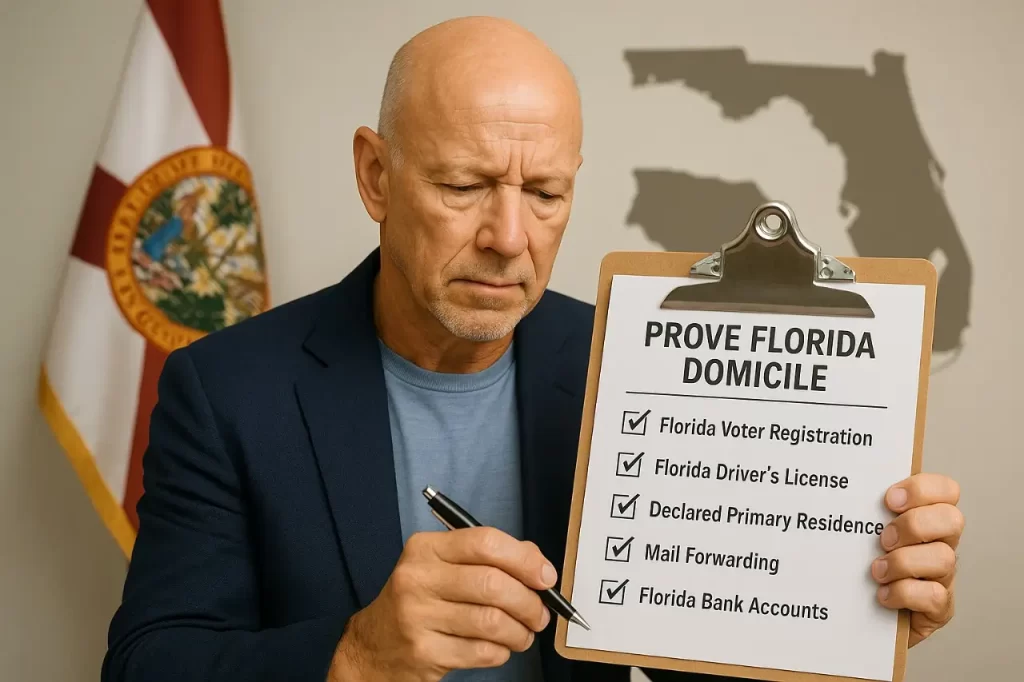
Florida domicile involves clear steps:
- Acquiring a primary Florida residence.
- Obtaining a Florida driver’s license and voter registration.
- Shifting financial and personal records to Florida.
- Spending over half the year physically present in Florida.
Our firm specializes in domicile transfers, ensuring seamless, compliant moves to protect your wealth.
Common Mistakes in Connecticut to Florida Estate Planning
Avoid these costly errors:
- Insufficient days physically present in Florida.
- Retaining significant ties to the former state.
- Failing to properly document residency changes.
Professional guidance is essential.
My Experience Helping Affluent Clients Escape High-Tax States
Since founding my firm in 2016, I’ve dedicated myself to guiding affluent families through domicile transitions and comprehensive estate planning. My mission is ensuring that clients avoid unnecessary taxation and family conflicts through meticulous and strategic legal planning.
Example: When Connecticut Domicile Planning Goes Wrong

Consider “Father,” a successful Connecticut entrepreneur who partially moved to Florida but maintained significant ties to Connecticut. Upon his unexpected death, Connecticut authorities aggressively contested his domicile claim, subjecting his estate to millions in avoidable taxes. His children, “Son” and “Daughter,” faced painful decisions about liquidating cherished assets. Had “Father” clearly established Florida domicile, his legacy could have remained intact and untaxed by Connecticut.
Breakdown: How Florida Domicile Secures Estate Wealth
“Father’s” domicile ambiguity triggered Connecticut’s “clear and convincing evidence” standard, ultimately costing the estate approximately $4 million in avoidable taxes. Proper domicile planning and asset transfers would have shielded his estate entirely from Connecticut’s aggressive tax enforcement.
Why Connecticut to Florida Estate Planning Is Personal to Me
Estate planning isn’t merely a professional endeavor—it’s deeply personal. I witnessed firsthand the devastating effects of poor planning in my family, fueling my passion for helping others avoid similar outcomes. I approach every client’s situation with empathy and a determination to protect their legacy and family harmony. My greatest reward is seeing families secure and confident in their financial futures.
Books Worth Reading
- The Essential Guide to Florida Estate Planning
- Star Spangled Planner
- Global Family’s Guide to US Inheritance Law – Gold Card Advantage
- The Florida Realtor’s Guide to Probate Properties
Fun Learning with Celebrity News Videos
You have three ways to contact me:
- Call: (305)634-7790
- Email: JO@JOValentino.com
- Contact Form: www.JOValentino.com/contact
FAQs
1: Why are wealthy families leaving Connecticut for Florida?
Connecticut’s high estate and income taxes create a heavy burden. Florida offers no estate tax, no income tax, and strong asset protection.
2: What is domicile and how does it affect estate taxes?
Your state of domicile determines which state can tax your estate. Establishing Florida domicile protects assets from Connecticut’s 12% estate tax.
3: What are the steps to shift domicile from Connecticut to Florida?
Buy a Florida primary home, register to vote and drive in Florida, change tax filings and spend most of your time in Florida.
4: How much did Barry Sternlicht save by moving?
He potentially saved over $400 million in estate tax and $10 million annually in income tax by relocating to Florida.
5: What if Connecticut challenges my domicile?
You must prove your Florida residency with “clear and convincing evidence.” Courts look at your behavior, not just your paperwork.
Disclaimer
This article is for informational purposes only and does not constitute legal advice or create an attorney-client relationship. Reading this does not make me your lawyer – I can only accept that role through a signed written agreement with you, after we’ve both agreed to it. Every situation is unique, and laws change. Please consult me (or another qualified attorney) for advice tailored to your specific circumstances. Until you receive a signed writing from me confirming I’ve agreed to be your attorney, please do not assume any guidance here applies to your exact situation. I am licensed in Florida, and any references to laws are based on the current statutes and rules as of the time of writing. I strive for accuracy, but I cannot guarantee that all information here remains up-to-date or applicable to all readers. In short: Let’s talk one-on-one before making big decisions. I’m here when you’re ready.
Thank you for reading, and I wish you and your family the very best in wealth, health, and happiness.




Share: